

The digital landscape is undergoing a monumental shift. For years, SEO has been a game of ranking in the top ten blue links. Now, with the rise of Google’s AI Overviews and other generative AI search engines, the goal has changed. Success is no longer just about visibility; it’s about being the source of truth for a direct, synthesized answer. Creating effective content for AI search requires a new approach.
Many businesses are struggling to adapt, finding their traditional SEO strategies less effective. This guide provides a practical, actionable framework to move beyond outdated tactics. We’ll explore how to structure content that Large Language Models (LLMs) can easily understand, trust, and cite, ensuring your expertise is featured in the new era of search.
Table of Contents
- What is AI-Powered Search and Why Does It Matter?
- The Core Principle: Structuring Content for LLM Consumption
- Building Topical Authority with Entity-Based SEO
- E-E-A-T: Proving Your Content’s Value to AI Systems
- Practical Application: A 5-Step Checklist for AI-Optimized Content
- Tools and Technology for AI Search Optimization
- Common Mistakes to Avoid in AI Search Optimization
- Frequently Asked Questions
What is AI-Powered Search and Why Does It Matter?
AI-powered search is an evolution from a list of links to a direct answer engine that synthesizes information from multiple sources to provide a single, comprehensive response to a user’s query. This shift, exemplified by technologies like Google’s AI Overviews, has profound implications for website traffic and content strategy, as success now hinges on being cited within the AI’s answer.
At its core, AI search is driven by Large Language Models (LLMs) and knowledge graphs. LLMs provide the reasoning and language generation, while knowledge graphs supply structured data about entities (people, places, concepts) and their relationships. This combination allows the engine to understand user intent with incredible nuance and deliver answers, not just links. For businesses, this means it’s critical to be the source material for the AI’s answer.
The Core Principle: Structuring Content for LLM Consumption
LLM-friendly content structure involves organizing information into a clear, logical hierarchy that machines can easily parse to extract direct answers. To optimize content for AI search, you must abandon long, unstructured walls of text in favor of a highly organized format that clearly delineates concepts and their relationships. A key strategy is to create ‘extractable knowledge blocks’—self-contained, concise chunks of information that directly answer a specific question.
Key structural elements include:
- Clear Hierarchies: Use HTML headings (H1, H2, H3) correctly and logically to create a clear outline.
- Concise Paragraphs: Keep paragraphs short, focusing on a single core idea to improve readability for humans and machines.
- Bulleted and Numbered Lists: Break down processes, features, or key points into easily digestible formats.
- Structured Data Tables: Use tables to compare features or data points in a machine-readable way.
Building Topical Authority with Entity-Based SEO
Entity-based SEO is the practice of optimizing content around topics and concepts, rather than just keywords, to establish comprehensive authority that AI search engines can trust. AI search engines think in terms of entities and topics. An entity is any well-defined concept, like a company, a product, or a scientific theory. This approach requires building content that comprehensively covers these entities and clarifies their relationships, establishing your site as an authority.
Instead of just targeting a keyword, an entity-based approach provides context. This is achieved by covering related sub-topics and using structured data (like Schema.org) to explicitly tell search engines what your content is about. This depth and clarity help AI systems recognize your expertise, making your content a more reliable source for AI-generated answers.
E-E-A-T: Proving Your Content’s Value to AI Systems
Google’s E-E-A-T (Experience, Expertise, Authoritativeness, and Trust) guidelines are more critical than ever for AI search optimization. According to Google’s Search Quality Rater Guidelines, content must demonstrate these qualities to be considered high-quality. While Expertise, Authoritativeness, and Trust remain vital, the ‘Experience’ component has become a key differentiator in the age of AI.
Experience signals that the content is based on first-hand use or real-world application. AI systems are being trained to identify and prioritize unique insights that can only come from genuine experience. Here’s a practical example of how to inject this signal:
Injecting Experience: Before & After
Before (Generic Statement):
“Using this project management software improves team efficiency.”After (Experience-Rich Statement):
“In our three-month trial with a team of five, the software’s automation feature reduced our weekly reporting time by an average of 4 hours. Specifically, it automated data consolidation from three separate platforms—a benefit not highlighted in the official documentation.”
This ‘After’ example provides specific data (three months, five people, 4 hours), a unique insight (undocumented benefit), and demonstrates hands-on use, which are powerful E-E-A-T signals for AI search.
Practical Application: A 5-Step Checklist for AI-Optimized Content
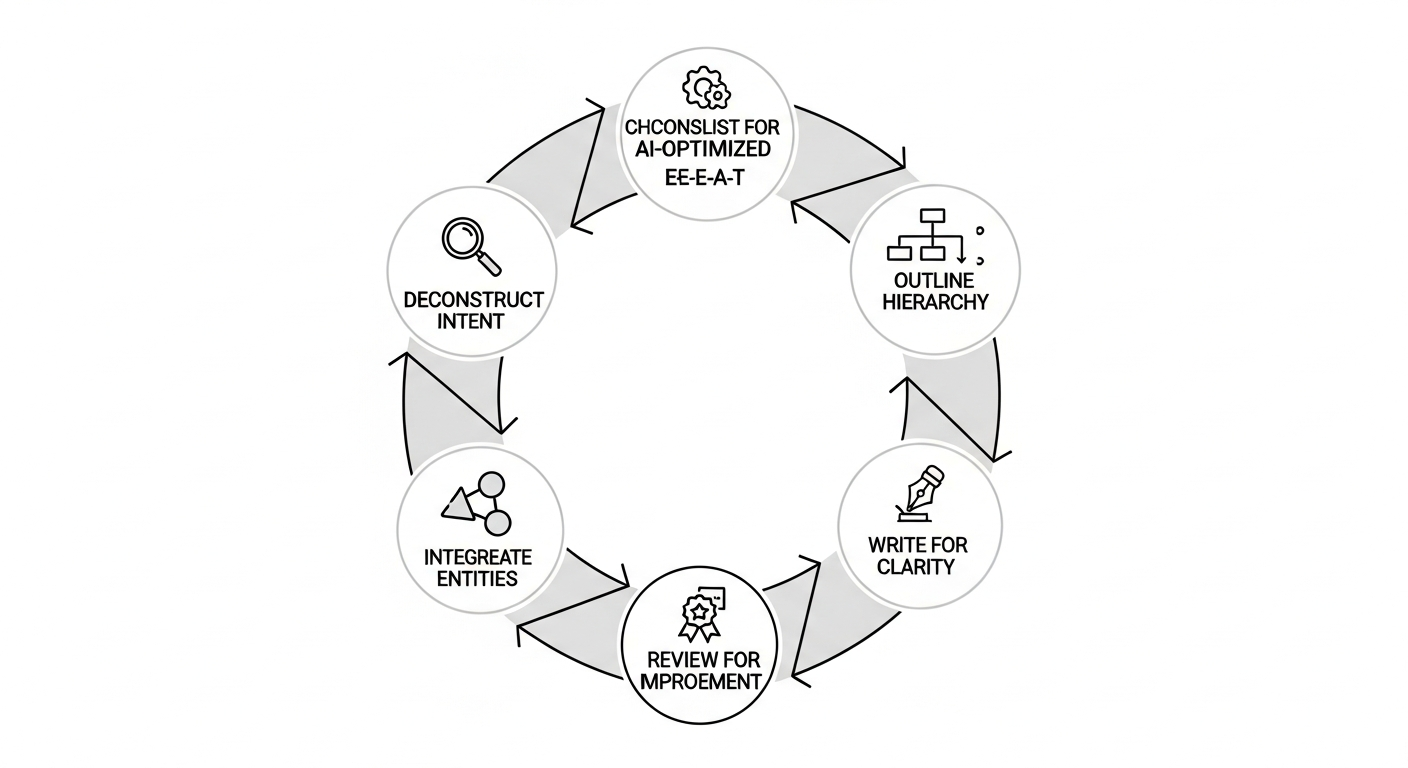
This five-step checklist provides a repeatable process for creating and optimizing content for generative engine optimization (GEO).
- Deconstruct User Intent: Start by identifying the primary question your user is asking. Then, break that down into all the potential follow-up questions they might have. These sub-questions will become the sections of your article.
- Outline with an Answer-First Hierarchy: Create a logical outline using H2 and H3 headings for each sub-question. Plan to begin each section with a direct, concise answer (the ‘knowledge block’).
- Write for Clarity and Create Knowledge Blocks: Write the full content, focusing on clear, simple language. Use short paragraphs, lists, and tables. Ensure each section can stand alone as a coherent answer.
- Integrate Entities and Add Structured Data: Naturally weave in related entities and concepts to build topical authority. After writing, implement relevant Schema.org markup to explicitly define key entities. Focus on these valuable schema types:
- `Article` Schema: Defines the author, publisher, and publication dates, establishing credibility.
- `FAQPage` Schema: Makes your questions and answers eligible for rich results and direct inclusion in AI answers.
- `HowTo` Schema: Structures step-by-step instructions in a machine-readable format.
- `Person` Schema: Can be used on author pages to build out an individual’s expertise and connect them to the content they’ve created.
- Review for E-E-A-T Signals: Read through the final draft specifically looking for opportunities to add signals of Experience. Add unique insights, original data, or practical tips that demonstrate hands-on knowledge.
Tools and Technology for AI Search Optimization
To make this framework more tangible, here are tools that can help at various stages of the process:
- For Deconstructing User Intent (Step 1): Tools like AlsoAsked.com, AnswerThePublic, and Google’s ‘People Also Ask’ feature are excellent for discovering the sub-questions and related queries your audience has.
- For Entity Analysis (Step 4): Platforms like InLinks, Clearscope, or SurferSEO offer entity analysis features that help you identify related concepts and entities you should include to build topical authority.
Traditional SEO vs. AI Search Optimization
| Factor | Traditional SEO Approach | AI-Optimized Approach |
|---|---|---|
| Content Focus | Keyword-centric | User intent and question-centric |
| Unit of Importance | The Web Page | The Extractable Knowledge Block |
| Structure | Long-form prose is common | Strict, logical hierarchy is mandatory |
| Primary Goal | Rank in the top 10 links | Be cited directly in the AI-generated answer |
| Key Tactic | Keyword placement and backlinks | Topical authority and E-E-A-T signals |
Common Mistakes to Avoid in AI Search Optimization
As with any evolution in SEO, common pitfalls can hinder progress. A common mistake businesses make is adapting tactics without changing their underlying strategy. Avoid these errors to stay ahead:
- Ignoring the ‘Experience’ Signal: Content that lacks unique insights or real-world examples will be seen as generic and less valuable by AI systems.
- Writing Long, Unstructured Paragraphs: Dense blocks of text without clear headings are difficult for users and machines to digest, making your content less likely to be used.
- Focusing Solely on a Single Primary Keyword: AI search understands topics. Over-optimizing for one keyword while ignoring related concepts fails to build the topical authority necessary to be seen as a credible source.
Frequently Asked Questions
How is AI search fundamentally different from traditional Google search?
Traditional search focuses on ranking a list of documents (links) based on relevance signals. AI search aims to synthesize information from multiple sources to provide a direct, comprehensive answer to a user’s query, often presenting this answer above the traditional links. This makes being the source of a fact more important than just being a link on the page.
Does keyword density still matter when creating content for AI search?
No, keyword density is an outdated concept. AI search focuses on understanding topics and entities. Instead of repeating keywords, you should cover a topic comprehensively, using related terms and concepts naturally to establish topical authority. The goal is depth and clarity, not repetition.
What is the single most important change I can make to my content today?
Improve its structure. Break down long-form content into clearly defined sections with descriptive headings (H2s, H3s). Ensure each section begins by answering a specific sub-question concisely. This makes your content easily parsable for AI models looking for extractable information to feature in answers.
The Strategic Shift to Clarity and Authority
Optimizing content for AI search is not about finding a new trick or loophole. It’s a strategic shift toward creating the clearest, most authoritative, and most helpful content on the web. By focusing on structured data, topical authority, and demonstrating genuine experience, you align your content with the core objectives of next-generation search engines.
The principles of providing direct value and organizing information logically are timeless. By embracing this framework, you aren’t just optimizing for machines; you are creating a better, more valuable experience for your human audience, ensuring your expertise remains visible and relevant for years to come.