

The rise of powerful AI writing tools has revolutionized content creation, but it has also given rise to a new challenge: AI content detection. For marketers, SEOs, and publishers, understanding how these detectors work, their limitations, and Google’s official stance is no longer optional—it’s essential for a future-proof content strategy. This guide breaks down everything you need to know.
We will explore the technology behind AI detection, analyze the accuracy of popular tools, and provide a strategic framework for using AI to create high-quality, valuable content that search engines and audiences love, without fearing penalties.
Table of Contents
- Understanding AI Content Detection: What It Is and Why It Matters
- How Do AI Content Detectors Actually Work?
- The Million-Dollar Question: How Accurate Are AI Detectors?
- Google’s Stance on AI Content: Separating Fact from Fiction
- A Strategic Framework for Using AI in Content Creation
- Putting Theory into Practice: A Walkthrough
- What About AI Humanizers and Bypassing Tools?
- Comparing the Top AI Content Detection Tools
- The Future of Content Creation and Detection
- Frequently Asked Questions
Understanding AI Content Detection: What It Is and Why It Matters
AI content detection is the process of using algorithms to analyze a piece of text and determine the probability that it was generated by a large language model (LLM) rather than a human. These tools are becoming increasingly important as businesses and creators navigate the integration of AI into their content workflows.
Defining AI Content Detection in Plain English
In simple terms, an AI content detector is a specialized software that reads text and looks for linguistic patterns characteristic of machine-generated writing. It doesn’t check for factual accuracy or quality; its sole purpose is to identify the statistical likelihood of a text’s origin—human or AI.
The Core Goal: Identifying Patterns, Not Plagiarism
A crucial distinction to make is between AI detection and plagiarism checking. A plagiarism checker compares text against a massive database of existing content to find copied passages. In contrast, an AI detector analyzes the intrinsic qualities of the text itself, such as sentence structure, word choice, and predictability, to make its assessment.
How Do AI Content Detectors Actually Work?
AI content detectors rely on principles from Natural Language Processing (NLP) and machine learning to spot the subtle signatures left by AI writers. The two most important concepts they analyze are perplexity and burstiness.
The Concept of Perplexity: Measuring Text Predictability
Perplexity measures how predictable a sequence of words is. AI models, trained to predict the most likely next word, tend to produce text with low perplexity—it’s often very smooth, logical, and uses common word combinations. Human writing, on the other hand, is filled with more surprising word choices and varied sentence structures, resulting in higher perplexity.
Analyzing Burstiness: The Rhythm of Human vs. Machine Writing
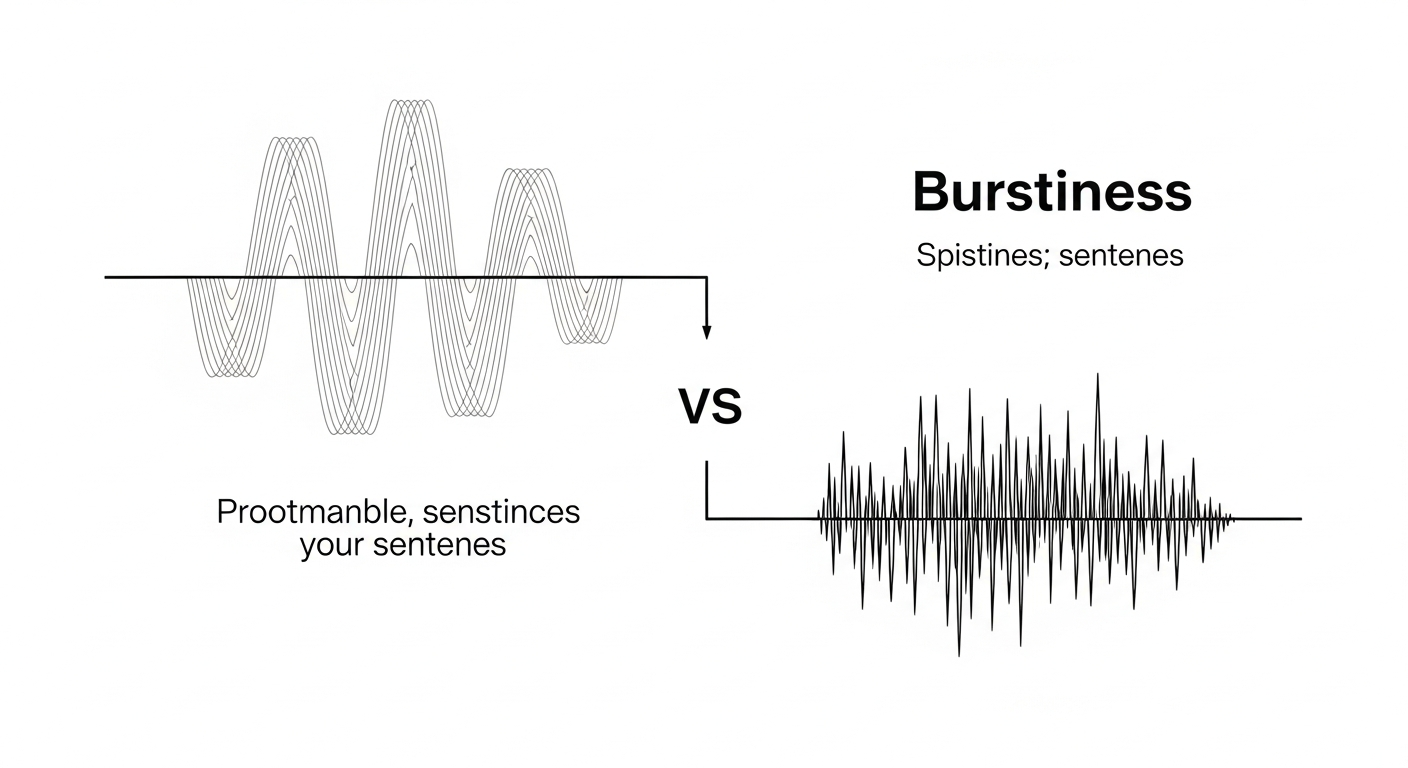
Burstiness refers to the variation in sentence length and complexity. Humans naturally write in bursts, with a mix of long, complex sentences and short, punchy ones. AI-generated text often lacks this rhythm, exhibiting a more uniform sentence structure. Detectors analyze this “burstiness” to gauge how human-like the writing style is.
The Challenge of Evolving LLMs
An important factor to consider is the rapid evolution of the models themselves. Content from advanced LLMs like GPT-4 or Claude 3 is inherently harder to detect than output from older models. This is because their improved training allows them to generate text with more natural perplexity and burstiness, effectively mimicking human writing patterns more closely.
The Million-Dollar Question: How Accurate Are AI Detectors?
The accuracy of AI content detectors is a subject of intense debate, and the reality is that no tool is infallible. While they can be a useful guide, they should not be treated as an absolute judge of a text’s origin. Independent studies have highlighted the challenges with reliability, making a human-in-the-loop approach essential.
Key limitations of AI detectors include:
- False Positives: Incorrectly flagging human writing, especially non-native or highly structured text.
- Hybrid Content: Difficulty analyzing text that is part AI-drafted and part human-edited.
- Language and Topic Bias: Lower accuracy for non-English content and highly technical or creative topics.
- Evolving Models: Struggling to keep pace with the sophistication of the latest LLMs.
The Inherent Challenge of False Positives
One of the most significant issues is the risk of false positives. Over-reliance on these tools without human review can lead to unfair penalization of writers. In real-world implementations, we’ve seen detectors flag perfectly good human writing simply because it followed a formulaic structure, which is why these scores should be treated as a signal, not a verdict.
Google’s Stance on AI Content: Separating Fact from Fiction
Many content creators fear that using AI will result in a penalty from Google. However, Google’s official policy is more nuanced and focuses on content quality and value, not the method of production.
Official Policy: Rewarding Quality, Regardless of Origin
According to Google Search Central, their ranking systems aim to reward high-quality, original content that demonstrates qualities known as E-E-A-T: Experience, Expertise, Authoritativeness, and Trust. Google has explicitly stated that their focus is on the quality of the content, not how it was produced. This means that high-quality, AI-assisted content can rank just as well as human-written content.
Debunking the Myth of an ‘AI Penalty’
There is no specific penalty for using AI. The penalty is, and always has been, for creating low-quality, unhelpful content. If AI is used to mass-produce spammy articles designed solely to manipulate search rankings, that content will perform poorly—just as it would if a human had written it.
A Strategic Framework for Using AI in Content Creation
Instead of trying to “beat” AI detectors, the most effective approach is to build a robust, human-centric workflow that leverages AI as a powerful assistant. This ensures high quality and originality.
The ‘AI-Assisted’ Model: Using AI as a Tool, Not a Writer
Treat AI as a co-pilot. Use it for brainstorming, creating outlines, summarizing research, or drafting initial passages. The final product, however, must be shaped, refined, and owned by a human expert who can add nuance, perspective, and a unique voice.
A Checklist for Injecting E-E-A-T into AI Drafts
A common mistake businesses make is publishing generic AI content. To transform a sterile AI draft into a valuable asset, use this checklist to inject genuine experience and expertise:
- Add a direct quote from an in-house subject matter expert or industry leader.
- Insert a proprietary statistic or finding from your own data or customer surveys.
- Reference a brief, relevant customer story or a personal anecdote that illustrates a key point.
- Include unique visuals, such as a photo of your team using the product or a custom-made diagram.
- Link to an internal resource like a detailed case study, webinar, or whitepaper that provides deeper insight.
Putting Theory into Practice: A Walkthrough
Let’s look at a concrete example of how to humanize AI text. Here is a generic paragraph generated by an AI tool about customer support automation.
Original AI Draft:
“Automating customer support can be beneficial for businesses. It helps reduce response times and improves efficiency. By using AI chatbots, companies can handle more inquiries and provide 24/7 support, which leads to better customer satisfaction.”
AI Detector Score: 98% AI-Generated
The text is correct but lacks depth, authority, and experience. Now, here is the human-edited version designed to add E-E-A-T.
Human-Edited Version:
“Automating customer support isn’t just beneficial—it’s transformative. In our 2023 client report, we found that implementing an AI sales agent like IntelliAgent AI reduced initial response times by an average of 72%. One of our e-commerce partners, ‘Global Threads,’ was able to handle a 40% increase in holiday inquiries without hiring additional staff. This isn’t just about efficiency; it’s about providing instant, 24/7 support that builds trust and boosts customer lifetime value.”
Here’s exactly what we changed to add value:
- Added a specific data point: “reduced initial response times by an average of 72%” provides a hard statistic that demonstrates expertise.
- Included a brief case study: Mentioning “Global Threads” and their results makes the benefit tangible and credible.
- Used a stronger, more confident voice: Changing “can be beneficial” to “isn’t just beneficial—it’s transformative” reflects a strong, authoritative perspective.
- Connected features to value: The paragraph now links the feature (24/7 support) to a deeper business goal (building trust and boosting customer lifetime value).
What About AI Humanizers and Bypassing Tools?
A new category of tools has emerged: “AI humanizers” that claim to rewrite AI text to bypass detection. These tools typically work by swapping words with synonyms or restructuring sentences to increase perplexity.
However, using them carries significant risks. They can often strip the content of its original meaning, introduce grammatical errors, and make the text sound unnatural. More importantly, this approach misses the point. The goal isn’t to trick a detector; it’s to create high-quality content for humans. Focusing on tools to bypass detection is a short-term tactic that ignores the long-term strategy of building authority and trust with your audience and search engines.
Comparing the Top AI Content Detection Tools
Several tools dominate the AI detection market, each with slightly different strengths. Understanding their primary use cases can help you choose the right one for your workflow.
| Tool | Primary Use Case | Key Features | Pricing Model |
|---|---|---|---|
| Originality.ai | Serious content publishers, agencies, and SEOs. | Checks for AI, plagiarism, and readability in one scan. | Pay-as-you-go credits. |
| GPTZero | Educators and academic institutions. | Focuses on detailed sentence-by-sentence analysis and highlighting. | Freemium with paid tiers for higher volume. |
| Copyleaks | Enterprises and educational platforms. | Full-platform solution with LMS integration and code plagiarism detection. | Subscription-based. |
The Future of Content Creation and Detection
The relationship between AI content generation and detection is an evolving arms race. As AI models become more sophisticated, their output will become increasingly difficult to distinguish from human writing. This reality reinforces the need for a sustainable, quality-focused strategy.
Focusing on Value as the Ultimate Goal
Ultimately, the most future-proof content strategy is to obsess over providing genuine value to your audience. Whether you use AI or not, content that is insightful, accurate, engaging, and demonstrates true expertise will always have a place. This is the metric that both users and search engines value most.
Frequently Asked Questions
Will Google penalize my site for using AI-generated content?
No, Google’s official stance is that they reward high-quality content that is helpful to people, regardless of how it is produced. Their focus is on E-E-A-T (Experience, Expertise, Authoritativeness, Trust). AI content created solely to manipulate search rankings without providing value is considered spam.
Are AI content detectors 100% accurate?
No tool is 100% accurate. AI content checker tools can produce false positives (flagging human text as AI) and can be fooled by heavily edited or sophisticated AI-generated text. They should be used as a guide, not an absolute verdict.
How can I make my AI-assisted content pass detection?
Instead of trying to ‘trick’ detectors, focus on improving the content’s quality. Add personal experiences, unique insights, original data, and a distinct brand voice. Edit for flow, clarity, and factual accuracy. The goal is to create valuable content for humans, not to achieve a specific tool score.
What is the difference between an AI detector and a plagiarism checker?
A plagiarism checker compares text against a vast database of existing content to find direct copies. An AI content detector analyzes the linguistic patterns, structure, and predictability of the text itself to determine the probability that it was generated by a large language model.
By embracing AI as a tool to augment human expertise, you can enhance your content creation process while maintaining the high standards of quality and authenticity that lead to long-term success. Focusing on creating genuinely helpful content is the best way to thrive in the evolving digital landscape.